
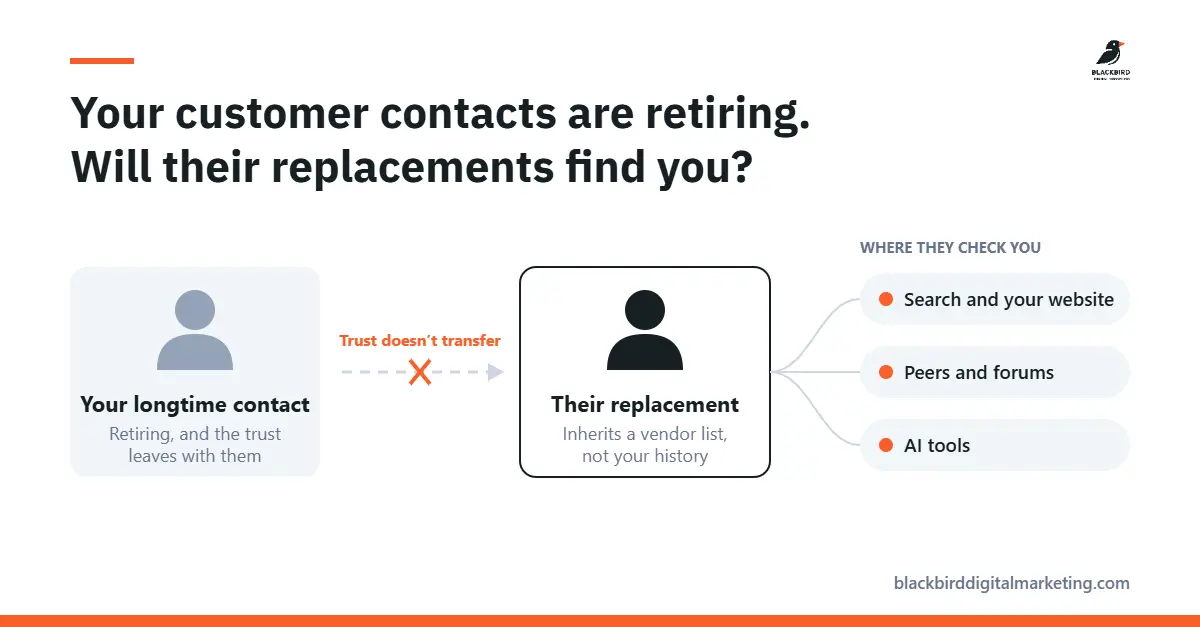
If your longtime customer contacts are retiring, the relationship you built with them is retiring too. The engineers replacing them won’t inherit your trust. They’ll inherit a vendor list, a search bar, and a few peers to ask. To get known by them, you have to be findable and credible before they ever call: a founder with a visible point of view, a website that answers real technical questions, and a presence in the places younger engineers go to check what peers think.
I’m a chemical engineer with an MBA, and I’ve spent more than 20 years marketing to technical buyers. For owners of engineering and industrial firms, it often shows up as a simple complaint: the phone doesn’t ring like it used to.
What happens to the account when your contact retires?
Picture the handoff. Your contact of fifteen years gets a retirement lunch. Maybe he mentions your name to his replacement on the way out. Maybe he doesn’t.
The new person gets his files. They don’t get the history: the night you sent a tech out on Christmas Eve, the bid where you told them to spend less. That trust lived in one person’s head, and it walked out the door with him.
So the replacement does what any careful engineer does with a new responsibility. They research. They search your company name, look at your website, check your founder on LinkedIn, and ask people they trust. If what they find is thin, you become “the vendor my predecessor liked,” which is a weak position the first time something goes wrong.
Where do younger engineers look first?
Not where your old contacts looked. EETech, the publisher behind All About Circuits and Control.com, surveys engineers every year. Discussing its 2025 Engineering Insights Report (3,000+ engineers), EETech’s Terra Gledhill said communities and forums have become the top resource for Millennial and Gen Z engineers, while career pros still rely on manufacturer websites (TREW Marketing podcast, December 5, 2025). The same discussion reported AI tool use among younger engineers rising from 45% to 64% in a year.
EETech groups engineers by experience, not age: “Millennial and Gen Z” means 14 or fewer years in the field, and “career pros” have 15 or more (EETech).
Two things follow from that.
First, your website still matters, but it’s no longer enough on its own. Second, the younger engineer wants to know what peers say about you. They’re looking for proof that you know what you’re doing from somewhere other than your own homepage.
They may not sign the PO. They decide who gets considered.
It’s easy to discount the younger engineer. In EETech’s Millennial/Z analysis of its Engineering Insights Report, 34% of career pros said they were final decision-makers, compared with 19.5% of Millennial and Gen Z engineers (EETech, 2026 report summary page).
Read that the wrong way and you’ll keep courting the senior person and ignore everyone else. I’d read it the other way. The younger engineer does the research, builds the shortlist, and hands it up. The senior person signs off on a list someone else made.
And shortlists form early. Forrester’s 2024 Buyers’ Journey Survey found that 92% of B2B buyers start a purchase with at least one vendor already in mind, and 41% have a single preferred vendor before formal evaluation begins (reported by Digital Commerce 360, July 7, 2025).
My opinion: the most important person in your pipeline right now might be a 30-something engineer reading forum threads at 9 p.m. You’ve probably never met them.
What doesn’t work when marketing to younger engineers
A few fixes I see firms try, and why they fall short:
- Waiting for referrals. Referrals come from people who know you. The replacements don’t, yet.
- Sending a sales rep to cold-call the new contact. The Brooks Group describes next-gen buyers as digital-first and “opposed to unnecessary interaction,” and warns that companies that don’t adapt “will keep wondering why the phone stopped ringing” (January 15, 2026). A cold call to someone who hasn’t checked you out yet lands as noise.
- Handing LinkedIn to a generalist agency. “Happy Engineers Week” graphics don’t tell a process engineer anything about how you think. Engineers can tell when the writer didn’t understand the work.
How to get known by the people replacing your contacts
Map the handoffs before they happen
List your top twenty accounts. Next to each, write your main contact, roughly how long until they retire or move on, and who is most likely to take their place. If you can’t name that person, you’ve found your risk.
Then ask your current contact for a real introduction while they’re still there. A good contact will be glad to do it. Most people want their successor set up well.
Make the founder findable
When the new engineer looks you up, they’ll look up the person at the top. Your LinkedIn profile should say what you know and what problems you solve, in plain language. I wrote about the most common profile mistakes in The Essential Red Flags That Undermine Your Executive Profile.
Publish the answers they’re searching for
Younger engineers are trying to get up to speed fast. They inherited a system, and the documentation may be thin. Write about the questions they’re asking: what drives cost on a migration, when to phase a cutover, what you’d check first on a plant you’ve never seen. Each piece is something they can forward to their boss, with your name on it.
Show up where peers talk
Forums, user groups, association committees, and LinkedIn comment threads are where the next generation compares notes. Answer questions there without pitching. One useful answer in the right thread can do more than a month of company-page posts.
Keep the volume low and the opinions real
You don’t need to post daily. One solid piece every week or two, in your own voice, with real judgment in it, is plenty. Screen everything for NDA and export-control issues before it goes out, and generalize client details so nobody can be identified.
Start with ten names
Here’s a task you can do this week. Write down your ten biggest accounts and the name of the person most likely to replace your current contact at each one. Then look yourself up the way that person would: your name, your company, your website. Ask whether what they’d find would earn you a call.
If the answer is no, that’s the work I do. I help founder-CEOs of industrial and engineering firms become the trusted voice their next generation of buyers finds first, without daily posting and without putting confidential work at risk. Book a 45-minute fit call, or start with the diagnostic to see where you stand.
Sources
- TREW Marketing, “Comparing Research Behaviors of Career Pros and Next Gen Engineers”, Content Marketing, Engineered podcast, December 5, 2025.
- EETech, “2026 Engineering Insights Report: Millennial/Z Analysis”.
- EETech, “Millennial/Gen Z Report: How Millennial and Gen Z Engineers Differ from Their Seasoned Peers”.
- Digital Commerce 360, “Forrester: B2B buyers choose vendors before the buying process begins”, July 7, 2025.
- Michelle Richardson, The Brooks Group, “Modern Sales Strategy: How to Reach Next-Gen Buyers”, January 15, 2026.